You want to learn to read tarot but you’re daunted by the idea of learning 78 card meanings.
I get that. It feels overwhelming.
For me, it didn’t help that when I used to try to do a card pull and search the web for the meanings, I’d land on all this icky flowery language about my “aligned abundance portal,” and “softening into your truth” and it made me super uncomfortable. I mean, who fucking talks like that? Not me, anyway.
I always wound up thinking that witchcraft suffers from an image problem, kind of like cannabis before legalization when the entire weed aesthetic was centered around rainbows, pot leaves, and Bob Marley graffiti. (I ended up writing a book about the tarot designed for people like me, who are allergic to goddess-centred lingo.)
Reading Tarot the Easy Way
Meanwhile, you’re just trying to figure out what the card is trying to say, so let’s strip this down to something you can use. Forget meaning, and just look at what’s happening in the image. This gets beginners reading immediately without having to memorize anything. BOOM.
Use the Rider Waite Smith Deck for this. There are probably thousands of decks out there from which to choose, but this deck, the most popular and best known, uses archetypal imagery that anyone can read.
Stop asking “what does this card mean?” and start asking “what’s happening in this image.” Treat the card like a scene, not a definition.
How it works: You look at the card, ay what’s going on (someone holding on, walking away, fighting, waiting), and match that to a real-life situation
Why it works: It trains you to see behavior instead of chase definitions. It’s a simple way to start reading right away without getting stuck or overwhelmed.
Example of Reading Tarot Through Images
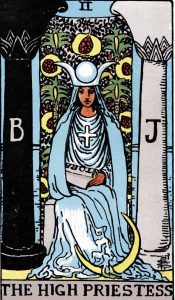
OK, shall we look an example? Let’s say you pull the High Priestess.
Step One: Describe It Literally
Who is in the card?
A woman
What is she doing?
Sitting regally between two very serious looking pillars, holding a scroll, looking priestessy.
Step Two: What does this suggest?
Well, pillars are usually serious business (These two represent Jachin and Boaz, two massive bronze pillars erected at the entrance of Solomon’s Temple in Jerusalem, but you are not required to know that). Combined with the scroll and the fact that she’s called The High Priestess, you can kind of guess that she’s an authority figure who reps feminine wisdom, which—stereotypically—relates to intuition. So, she’s about your intuition and respecting your own authority in your life.
What that means for you depends on where she shows up in a spread (we’ll get to spreads another day) and what you hope to get out of the reading. But those are the bare basics of the High Priestess.
Step Three: Translate to Behavior
So, what can we glean from this? This card could be about:
Trusting your intuition
Listening to subtext and looking beneath the surface
Calmly trusting yourself
Step Four: Apply It
Let’s say your question is:
“Should I say something, or leave it alone?”
If you’re trusting your intuition, listening to subtext, and looking beneath the surface, you might ask:
Where am I overriding my gut here?
What’s hiding behind or beneath the obvious?
Do I need more information before I act?
That points you toward the move:
Don’t react yet. Pay attention and let things play out a bit before deciding.
What to Ignore When Learning to Read Tarot Through Images
You can skip traditional meanings for the time being. You don’t need to know them yet. They’ll make more sense after you’ve learned how to look at a card, and make memorizing their meaning easier. You can also forget about “spiritual” interpretations. If you are the type that enjoys language that sounds like it belongs on a throw pillow (no shade. Despite what it looks like, I am not judging you), you can learn it later, but if it doesn’t connect to a real, observable situation, it’s not useful yet.
Why This Method of Tarot Reading Works for Learning
This method of reading tarot trains pattern recognition instead of memory and that shift alone makes everything easier and speeds up the process, because there’s no flipping through a book or second-guessing whether you got a definition right. You look at the card, translate what’s happening, and apply it. Plus, it forces you to engage. You can’t hide behind a keyword or a prewritten meaning. You have to actually think about the situation in front of you, which makes it easier to commit to memory.
Some Common Mistakes New Tarot Readers Make
Overcomplicating the image: If someone is walking away, they’re walking away. You don’t need to turn it into a metaphor about spiritual rebirth on your first pass.
Desperately digging for depth too: Beginners love to skip the obvious and jump to something “deeper.” The obvious is usually the right read.
Ignoring what’s right in front of you: You see it then you talk yourself out of it because it feels too simple. Stop doing that.
Quick Tarot Practice
Pull one card a day
Describe → translate → apply: What’s happening → what behavior is that → where is that showing up?
No guidebook: If you check the meaning after, fine. But do your read first.
What Happens Next in Your Tarot Practice
After a while you start seeing the patterns. The same cards applied to different situations result in new interpretations. Later, when you learn the traditional meanings of the cards, you will usually realize you were already there.
And if you do want to read further, you can get my book on Amazon
No Magic Required: Tarot for People Who Think Tarot is Bullshit